Monday, December 14, 2020

That kindly 'uncle Dave' and some pithy notes

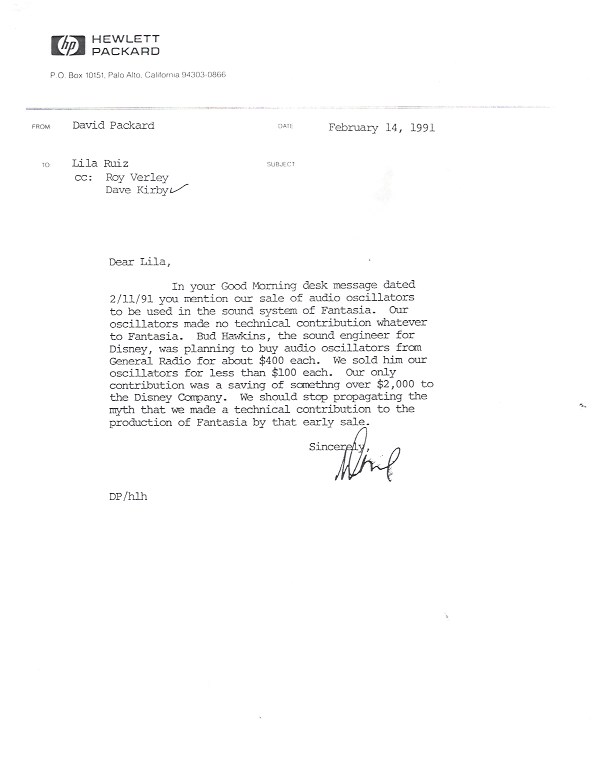
Cleaning up some old files, and getting ready for yet another personal move (this time from California to Washington to be nearer to our grandchildren), I found some vintage David Packard memos.

Many folk who joined HP from about 1971 onward (about the time Packard was returning from the Defense Department) had this view that Packard was a demi-god, with wisdom and perspective, to whom we could all turn for advice and assistance.   Not exactly doddering, but beneficent and kindly. 

Old-timers knew better, and one shared two notes with me (that should have been included in The HP Phenomenon, but weren't).     Dave's handwriting was not exactly fine penmanship, but it certainly conveyed authenticity.

The third note came out n 1991, near the end of Dave' s 'tour of duty' at HP, when a San Jose Mercury-News story described HP origins without asking Dave. 


Note 1: Sent to Al Bagley, General Manager of the F&T division, circa 1957:   "Bagley     This is both a waste of money and a violation of policy!    DP

Note 2: Note to WFC (Frank Cavier, CFO) and Van B (Ed van Bronkhorst, Corp Treasurer) and Jack Brigham (Corp Sec'y), circa Packard's chief nemesis--Excess Inventory.   He used these examples for the 1966 tour around the company, and again in 1973 to stop HP from borrowing money.  This note is undated, but said to be from the latter "Give 'em Hell" speeches he led (against Hewlett, no less).


And, years later, still strident, in a note to a young, hapless PR woman:


Friday, December 4, 2020

HOUSTON? Honestly, Dorothy, we're not in Kansas any more

 HOUSTON?   Really?   It was bad enough when Palo Alto was forsaken by HP (or was it HPE?), arguing that San Jose was more 'hospitable'.    But Houston?    So Compaq finally won after all?   Even though the Compaq products are more significant for HP Inc. than for HPE?

Oh, sorry, I forgot that Tandem, another Bay Area start-up, is the chief residual product family for HPE, and that was acquired for HP via the Compaq acquisition (or merger, or take-over . . . ).

So the San Jose Mercury-News story spends much time explaining that the "new San Jose" headquarters will now be repurposed to become the lead for HP Labs and a host of researchy-like things, and TRUST US,  the employment in the area will NOT BE AFFECTED.   Right, except maybe for the salary ranges.

And the Houston Chronicle spends much time saying that even though it won't change employment in Houston either, it will be "A RENAISSANCE" for the area, since HP is such a bellwether attraction for other company leaderships.   Really?   Google might be, but HP?   These days?

The Washington Post had a somewhat different slant on the story.   It foretells a MUCH LARGER HPE Houston https://abc13.com/hp-enterprise-moving-headquarters-from-california-to-texas-spring-tech-giant/8421335/  Since they quoted CEO Antonio Neri, it might be closer to the truth: “As we look to the future, our business needs, opportunities for cost savings, and team members’ preferences about the future of work, we are excited to relocate HPE’s headquarters to the Houston region,” CEO Antonio Neri said in a written statement Tuesday.

I don't quite understand the comment:"team members' preferences about the future of work"  Wasn't it HP that Rob Enderle extolled in ComputerWorld in May about "remote work"? Rob is that rare commentator who still says what's on his mind without regard for politics.  https://www.computerworld.com/article/3546255/the-hp-example-how-to-do-collaboration-and-remote-work-right.html   Title: The HP example: How to do collaboration and remote work right  First Sentence:  Companies that figure out how to carry on successfully with a distributed workforce can emerge from the ongoing pandemic stronger than before. HP offers lessons on how to do that."   Note that he did NOT say, "by moving to Houston"

So. lessee, now.   Agilent moved to Santa Clara from Palo Alto; Keysight moved from Santa Clara to Santa Rosa; HPE moved from Palo Alto to San Jose to Houston.  Oh, yes, there is still HP Inc.  (or HP INK, as some call it). and it's still in Palo Alto, right?

Would Hewlett and Packard be rolling in their graves?  Or had they long since quit worrying?

Where has the time gone? And where did "Free Ink" go?

 There undoubtedly are those who think this Blog has ended (some might say, mercifully).   SURPRISE!

I'm still alive and kickin', a Covid bout in March notwithstanding, and still interested in things HP.  It's just that my connections with the company have been much more modest in recent years, and if there's nothing to say except pass along Obituaries of PIPs (Previously Important People), it seems almost wasted ink.

Oh, THERE's a topic.   INK, as in HP Ink-Jets and derivatives.    Chris Goward, who runs a fabulous consulting firm called WiderFunnel, recently interviewed Anthony Napolitano, who runs the HP service business regarding "Ink as a Service".   See the short Facebook clip showing Anthony and the idea: https://www.facebook.com/watch/?v=303711624104243

I did a most enjoyable workshop for VP Steve Nigro and about 100 HP execs in the printing world in 2013.   Steve retired from HP in 2019.   Many know of Steve's impressive resume: 

Stephen Nigro is an industry veteran who has spent more than 37 years at HP working in a variety of capacities, most recently as President of 3D Printing, overseeing the global build out and execution of that business segment. Prior to that, Nigro was Senior Vice President of Imaging and Printing, leading all of HP’s printing businesses including HP Inkjet, HP LaserJet and HP Graphics.

Other senior leadership positions at HP that were held in the past by Nigro, included Senior Vice President of Inkjet and Graphics business, Senior Vice President of Retail and Web Solutions, Senior Vice President of Graphics and Imaging, and Senior Vice President of Technology Platforms.

Most notably, Nigro led the creation of the graphics arts business, 3D business and expansion of HP’s global inkjet business.

Nigro holds a Masters in Electrical Engineering from Stanford University and a Bachelors in Mechanical Engineering from UC Santa Barbara.

Out of that workshop, the "Ink as a Service" idea gained strength, and Napolitano has led it since.  I was invited to become a 'charter member' and we in fact did use it for awhile, but it was designed for the casual home-user (as in 15 pages per month), and we are prodigious users of HP printers and ink for reasons I'll spare you for now.

Then along came the Marketeers, and it became "FREE INK FOR A LIFETIME" (which, for our usage would have been welcome indeed--we spend ten times the our printers' cost for ink for them annually).

But today, comes this surprise announcement (granted, it is from Apple News, and hence suspect)" Read in Mashable: https://apple.news/AWfe5V5WMTRa3OEuTGlImyQ

It turns out HP's "free ink for life" plan wasn't actually "for life."

HP recently informed Instant Ink plan customers that after just three years, it was ending its "free ink for life" deal, according to Consumer Reports. It becomes not-so-free as of Friday.

What was this deal? The company remotely monitored printer buyers' ink usage (creepy!), and sent a "free" cartridge when they were running low...with some caveats.

Printing (and ink) was not unlimited. Users were allowed to print 15 pages per month. Subscribers also had to have a credit card on file with HP. If you went over 15 pages, HP would charge you a dollar for 10 additional pages. 

Oh, another fun component of the plan: Every five pages, HP would PRINT AN AD on your printer. Don't worry, the ad wouldn't count against your quota. Phew!

But now those halcyon days are gone. HP will charge participants in the program 99 cents per month for their 15 pages. Sure, nearly $12 a year doesn't sound like a lot, but, again, they signed up for FREE ink for life.

There are tiers that cost between 99 cents to $24.99/month for more pages, based on your printing needs. One positive change to the plan is that you can roll over your unused pages up to a cap.

The bait-and-switch "free ink for life" deal is just the latest trick pulled by HP (and other printer companies) to make as much money as possible from their machines. Writer Cory Doctorow broke down how HP has milked its customers dry with “security chips” in ink cartridges that stop your printer from working if you try to use (cheaper) ink from a third party.

Printer makers face the same challenge as every other hardware company: How to get people to keep spending money once they've made the initial investment. The winning formula is subscriptions, which is why you see tiered pricing plans for everything from fitness classes on Peloton to cloud storage from Apple. So, of course, Big Printer is in on the action. 

We've been tempted but never tried to use (cheaper) ink from a third party, so I don't know if my workhorse HP 8600 OfficeJet Pro (or my wife's either) have these reputed 'security chips' installed.  I do know from bitter experience at several past companies that our HP printers have been far more reliable and dependable than those that places like Stanford have tried for cost reasons.  But I bridle (or is it bristle) when someone asserts that the machine is set up to detect 'false ink' whether in fact it is or not.  Shades of the Shell gas truck stopping to fill the reservoir at 7-Eleven, but your Shell card doesn't work.

Thursday, December 15, 2016

Roy Clay with Dave Packard

One of the curious things about HP's entry into computing is that neither of the founders seemed particularly stimulated about being in that business.  It was the fastest growing, most 'high tech' of the businesses emerging after World War II, but HP assiduously avoided joining the fray.  It wasn't for lack of talent.  Doug Engelbart hired into HP in 1957, only to discover that Hewlett in particular and Barney Oliver (running HP Labs) weren't interested.  He quit the next day, and found work at what became SRI, where he pioneered much of the modern PC world, starting with the mouse and networks.

They nearly let Kay Magleby go, but by defining the first HP computer as an Instrument controller, Packard was appeased enough to let the project proceed.  Clay would run afoul of Hewlett on several occasions, one being Clay's penchant for playing early morning golf before coming to work.  As Clay told us two days ago, he liked a 6:00 or 6:30 am starting time, which allowed finishing by 9:30 or so, and getting to work by noon.  Hewlett was incensed when he learned from son Jim what they were doing.  Jimm working for Clay,  also liked golf as it turned out.   Vindication for Clay and his team came when one night about ten pm Hewlett's home machine failed, and they answered his call to the plant since they were still working.

Magleby and Clay would go on to hire Jimmy Treybig, Jim Kasson, Mike Green and others who later formed the Tandem founding team when Hewlett got nervous and cancelled the Holiday Inn order because it was "too much business and not enough scientific"

Top managers for the computer group at HP were on a merry-go-round.  First Bob Grimm, then  Jack Melchor, then Tom Perkins, then Clay on an interim basis awaiting George Newman, followed by Carl Cottrell and Bill Terry before Paul Ely--eight GMs in five years, a worse record than HP CEOs since Carly.   Magleby gave up when Perkins was hired; Clay gave up when Newman was hired.  Perkins started a fabulous VC firm when he left, and promptly hired all of Clay's team, using Clay as an advisor.  

Packard was away at the Defense department for President Nixon; when he returned,  he asked Clay to return to HP "to get us out of computing altogether"--this mere months before the disastrous HP 3000 introduction in autumn 1972.  When Clay refused, Packard wouldn't talk to him for five years.  And then Paul Ely proved to be the right selection, and the rest, as they say, is history.

No wonder these names aren't enshrined--HP for several years was just 'not sure' whether this was a good idea.  And the cultural clash was profound as well.  Years later, both Hewlett and Packard would agree that actually they were timid, to say the least--Packard volunteering, "Well, we didn't really louse it up too badly."  Small solace for those who worked so hard to make HP successful in this game.

Wednesday, December 14, 2016

Interview with Roy Clay

Roy Clay, one of HP's unsung heroes,was beaming yesterday afternoon when I walked in.  He lives in Montclair, CA up above the Oakland Hills looking out across San Francisco Bay.  It's a pleasant modest home, up a winding curvy road that would be envied in Monaco.  He was seated in a wheelchair--at 88, he told me he was 'glad to be here,' that he felt a couple of years ago that he might not be.

The smile was the same as always; his shy but clear eyes and soft voice belied his strong handshake.  We'd last met a few years ago--maybe twelve--when Ray Price and I were doing research for our book, The HP Phenomenon.  Which, by the way, is still selling, and seems to have gotten a bit of rejuvenation with the new publishing of Robert Burgelman, Webb McKinney and Phil Meza's book about HP CEOs, Becoming Hewlett-Packard.  

For that interview in 2004,we did not have the benefit of much background material on Roy, but the past decade has been good for getting his legacy more firmly grounded.   And this time, with the enthusiastic support of Gardner Hendrie, a long-time Computer History Museum (CHM) devotee and the inventor of the first 16-bit minicomputer in the world (HP's was second), we managed to get a video crew into Clay's home to record his recollection of some of the tumultuous times and innovations that he experienced.

Clay was granted an op-ed piece in the San Jose Mercury-News in 2014, speaking to the Michael Brown shooting in Ferguson, Missouri.  Headline: "It could have been me!"  Clay indeed was arrested, handcuffed, and hauled out of town when a teen-ager just after World War II--fearing for his life.  A few years later, he was the first African-American (not called that, then) to graduate from St. Louis University, in mathematics.  He eventually found work at the fabled Lawrence Radiation (Livermore) Labs, but in the 1950s, blacks weren't allowed to buy a home in the Livermore Valley, so he commuted from San Francisco.  He recalled three other African-Americans on the staff at LRL.

A new opportunity opened in Palo Alto in 1962, when Minnesota-based start-up Control Data opened a software research center.  Clay not only was the first black hired in 'high-tech' in what would become Silicon Valley, he was the first CDC hire in Palo Alto, and CDC was the first computer company in the Valley building 'true computers' (IBM of course was already in the Valley, but only with a peripherals division, one that would invent nearly all disc drive technology).  Clay soon found that nothing important was going to happen in Palo Alto for CDC--everything of consequence was in Minnesota at headquarters (premonition of Xerox and XeroxPARC?) or at Seymour Cray's home in rural Wisconsin.

So he answered a small advertisement in the Palo Alto Times for a 'systems programmer' for Hewlett-Packard, and after a couple of interviews, Dave Packard and Kay Magleby hired him as HP's first professional software developer, and first professional African-American.   Clay recalled for us when he met Art Fong, HP's first Asian-American professional who had started for HP twenty years earlier.  Clay averred that Packard was merit-based and certainly 'color-blind' -- quite a trait for those times.

Our book mentions Clay's role several times, and is to date the only HP-based book that does so.  But we did not realize the degree to which Clay influenced things at a time that HP was pretty nervous about being in the computer business.   We'll cover some of that in subsequent posts, but for now, let me just note a couple of other factoids.

Clay nurtured other African-American colleagues, including Ken Coleman in his early career.  And Clay became Tom Perkins' 'go-to' guy for a while on Venture Capital 'evaluations,' especially for Tandem Computer since most of their early team came from HP, and in fact Clay had hired them.

We tallied it up--Clay was early at CDC and HP, and evaluated Tandem, Intel, and later Compaq for Perkins, and he trained Coleman who in turn was instrumental at Silicon Graphics and Apple, and Coleman's wife was likewise at Software Publishing which spawned a series of software firms.

So it isn't surprising that some later called him "the godfather of Silicon Valley software."  And in fact in 2003 he was inducted into the Silicon Valley Hall of Fame, alongside Hewlett and Packard and Noyce and Moore.  He is today quite proud of that, rightfully so.

But I was equally, maybe even more, pleased to learn what else he did.  For starters, he was the first African-American on the Palo Alto City Council, winning three terms and once becoming Vice Mayor.  And he was the first of his race to be allowed to join the Olympic Club in San Francisco (after they lost a lawsuit about women and minority exclusion)--although they ordered him 'never to show up.'   An order which he ignored--and a decade later, he became President of the Olympic Club Golf Association, organizing eventually the biggest tournaments they'd ever held.

We left his home somewhat awestruck by the glimpse we had gotten of this remarkable individual--not just for his accomplishments, but for his humility, his perseverance, and his perspective.  HP, and the Valley, and all of us really, have had such a privilege to have him in our community.

Monday, November 7, 2016

HP computing 50 YEARS today

I couldn't resist.  The Computer History Museum gave me carte blanche to write up a post for this auspicious day in HP history.

Here it is

http://www.computerhistory.org/atchm/50th-anniversary-of-the-hp-2116-minicomputer/

Enjoy

Wednesday, September 28, 2016

At 50, memories get fuzzy

I mentioned in the previous post, being honored to be included at the HP Labs 50th anniversary celebration.  I was surprised though that there was little focus on what the Labs did to begin, how they got started, who did what, and etc.  Even the products that emerged early weren't mentioned.

Now, this was the PC/handheld devices/printing group, so they might not be expected to enthuse about the HP2116A, which will have its 50th anniversary from introduction on November 7.   So the stories they had were about the imagination to look at a coffee brewer and think of an exploding ink jet bubble as a delivery mechanism for ink.  The HP 35 was prominent in the pictures, and there was an HP 9100, but no HP 2116 that I saw.

And the date for HP Labs founding wasn't exactly Sept 27.  It was November 1, 1966, just as so many other HP organizational things happened at the fiscal year start.  But in truth, Barney started HP Labs in 1961, when the four divisional labs were pulled out from under him, leaving him with what we called "Central Labs."  I was invited to join this group in July 1962, and I had to pass his 'test' of what conformal mapping and convolution integrals meant, and could I handle that mathematics.  (By the way, such math is today very important for computer graphics and 3D modeling).

I then joined the oscilloscope group, which proved fortuitous as a group for the Central Labs.  The issue was we would move to Colorado Springs in 1964, and several key members of the group (including Rod Carlson, Dick Monnier, and Kay Magleby) elected to stay in the Bay.  The 'scope lab was the only group at HP building tools for computer companies in the early 1960s--everyone else was busy with communication tools (radio, TV, and microwave).  I went to Springs.

Well, the upshot was that Magleby went to Stanford for a PhD on HP support, for Paul Stoft in the Central Labs.  He came back with the idea of an Instrument Controller, which became the 2116.  Dick Monnier led the HP 9100 project, the first computer with a built-in CRT; and Rod Carlson became the head of the Network Analyzer which used the 2116 as the data acquisition and processing engine for microwave data.   Meanwhile, I built the HP 1300A in C Springs as the HP 2116 CRT display--whien IBM, DEC, and virtually everyone else insisted that ASR-33 teletypes were enough.

So, in point of fact, HP Labs started not only its computer ideas long before November 1966, but also the semiconductor work for what we called Boff Diodes for sampling heads, three-five compound work that led to LEDs, and SSI for small-scale integration before the semiconductor houses were going.

Otherwise, you'd have to say, "Boy, this research lab not only researched, but productized the HP2116 in 7 days--almost Biblical in capability"

Great fun all the way around